
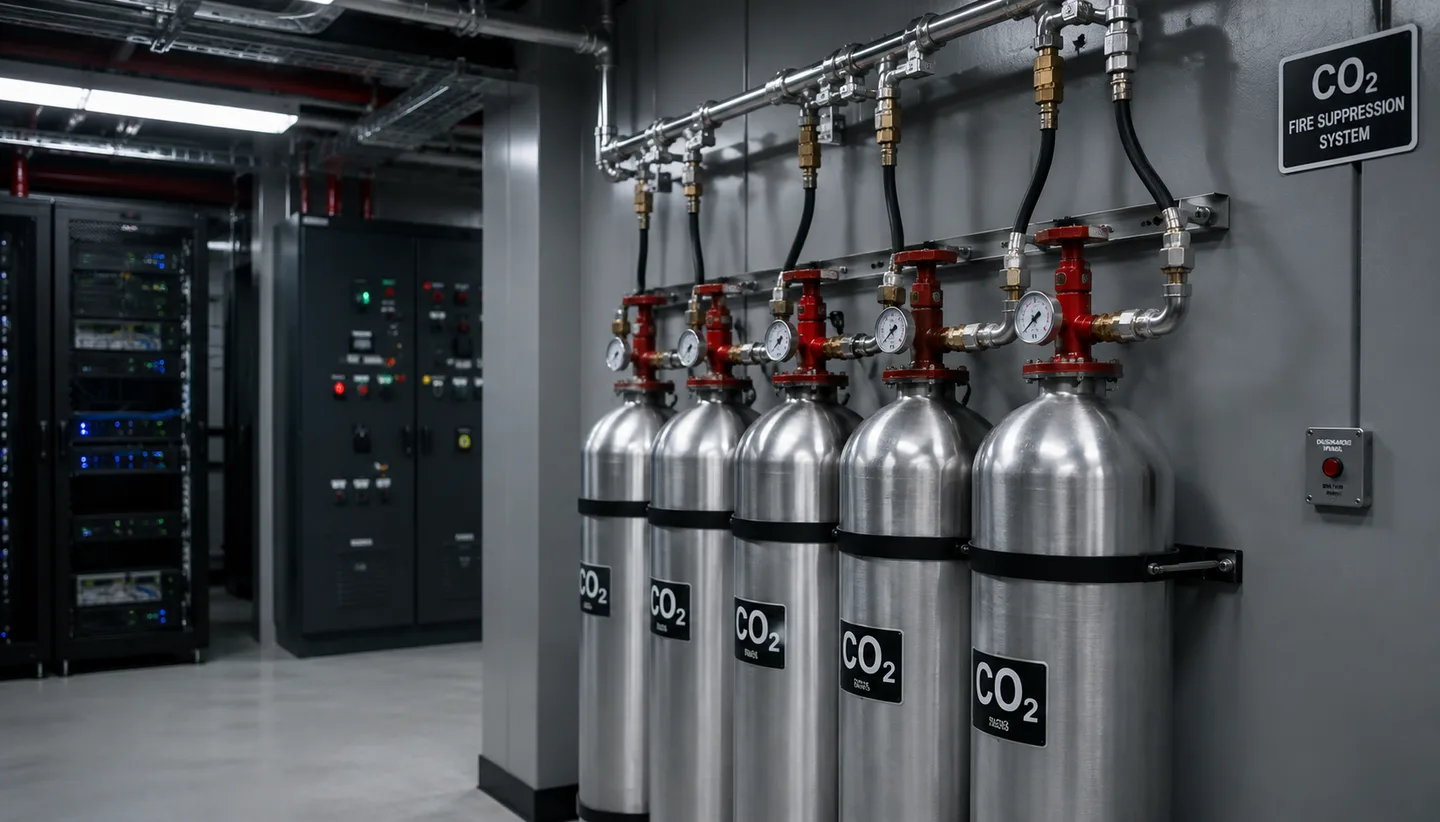
CO₂ Fire Suppression Systems in Egypt
CO₂ fire suppression systems for industrial hazards requiring total flooding or local application. High-expansion and deep-seat fire protection — NFPA 12 compliant engineering across Egypt.
CO₂ Fire Suppression Systems in Egypt
Carbon dioxide (CO₂) fire suppression systems extinguish fire by displacing oxygen in the protected space — reducing oxygen concentration below the level required to sustain combustion. CO₂ is electrically non-conductive, leaves no residue, and does not react with most industrial materials, making it effective in environments where chemical contamination or water damage cannot be tolerated.
CO₂ systems are designed for industrial applications: machinery spaces, printing operations, petroleum storage, generator rooms, and deep-seated industrial hazards where other suppression agents cannot penetrate the fuel source. The system can operate in total-flooding mode (filling an enclosed space) or local-application mode (discharging directly onto exposed hazards).
SOS designs CO₂ suppression systems to NFPA 12. Because CO₂ presents an asphyxiation hazard at fire-suppression concentrations, every SOS design incorporates pre-discharge time delays, lockout procedures, and alarm sequences that ensure personnel evacuation before agent release.
Where this system is required
- →Engine rooms, generator sets, and turbine enclosures
- →Petroleum storage tanks and flammable liquid hazards
- →Industrial printing and paper processing machinery
- →Painting booths and spray finishing equipment
- →Electrical switchgear in large industrial installations
- →Deep-seated combustibles in industrial storage
How we deliver this system
Four disciplined stages — from hydraulic design to formal commissioning. Engineering precedes execution on every project.

Design & Hydraulic Calculations
Site survey, hazard classification, and full hydraulic validation to the applicable NFPA standard — documented before any procurement begins.

Shop Drawings & Submittals
Coordinated shop drawings and material submittals approved by the authority having jurisdiction before installation commences.

Installation & Integration
Field installation by our technical teams with engineering oversight. Full integration with adjacent building safety systems.

Testing & Commissioning
Full functional testing, flow verification, and as-built documentation. Civil Defense inspection support and formal system handover.
Engineered to standard. Verified, not assumed.
Standard on Carbon Dioxide Extinguishing Systems
The primary standard governing CO₂ suppression system design, agent quantity, discharge rates, and safety requirements for occupied and unoccupied spaces.
National Fire Alarm and Signaling Code
Governs the detection and pre-discharge alarm sequence mandatory for all CO₂ systems protecting areas accessible to personnel.
Egyptian Civil Defense Regulations
Local authority coordination required for approval of gas suppression systems. SOS manages the full submission and approval process.
What clients ask about this system
CO₂ at suppression concentrations (typically 34%+ by volume) is immediately dangerous to life. For regularly occupied spaces, CO₂ is only used in local-application mode targeting specific equipment — not total flooding. Where total flooding is required, mandatory pre-discharge alarms and time delays ensure personnel evacuation before agent release.
CO₂ is preferred for industrial hazards where the scale of the protected space is large, the fire load is high, and human occupancy during suppression is not expected. FM200 is preferred for occupied technical spaces. SOS will recommend the appropriate agent for your specific hazard and occupancy profile.
NFPA 12 testing includes pneumatic checks of piping integrity, verification of agent quantity, detector and alarm functional tests, and discharge simulation. Full CO₂ discharge tests are performed as required and coordinated with Civil Defense inspection.
Complete fire protection, end to end
FM200 Suppression
Clean agent for sensitive environments where personnel may be present.
Learn moreFire Fighting Systems
Water-based suppression for facilities requiring NFPA 13 compliance.
Learn moreMaintenance & Inspection
CO₂ cylinder reweighing and system integrity testing per NFPA 12.
Learn moreRequest a technical proposal
Our engineering team reviews every inquiry and responds with technical precision — scope, applicable standards, and a clear path to compliance.
Request prepared
Your email client is opening with the details filled in. Send it and we'll respond shortly.