
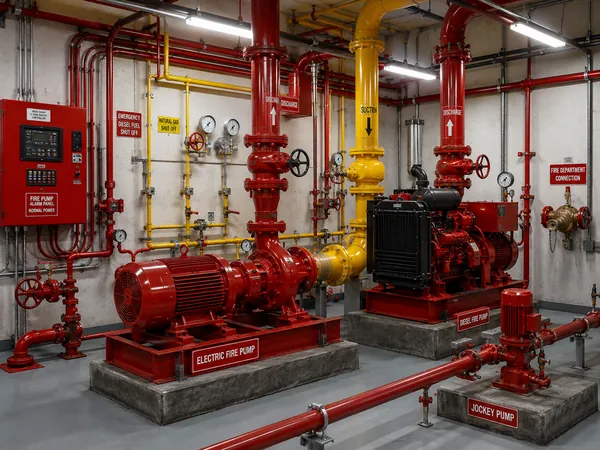
Fire Pump Room Installation in Egypt
Complete fire pump room design, supply, and installation for Egypt's commercial and industrial facilities. Diesel, electric, and jockey pump configurations per NFPA 20 — ensuring adequate pressure and flow.
Fire Pump Room Installation in Egypt
The fire pump room is the water supply heart of any fire protection system. It houses the pumps, controllers, pressure vessels, and related infrastructure that ensure water reaches every sprinkler head and hose connection at the correct pressure and flow rate — regardless of municipal supply variability or demand fluctuations across the building.
A fire pump installation typically consists of three components: the primary electric pump (main supply), the diesel-driven backup pump (independent of building power during fire events), and the jockey pump (maintaining system pressure between fire events and detecting leaks). SOS engineers each configuration to the specific hydraulic demands of your system — sized precisely to meet peak demand for the design fire scenario.
SOS designs and installs fire pump rooms to NFPA 20 — the Standard for the Installation of Stationary Pumps for Fire Protection. Our designs cover pump selection, driver sizing, controller specification, suction and discharge piping, pressure relief, flow test connections, and full room layout — coordinated with structural and MEP engineers from the outset.
Where this system is required
- →High-rise commercial and residential towers requiring boosted pressure
- →Large industrial facilities with high-demand sprinkler systems
- →Hotels and hospitality venues with multiple fire zones
- →Hospitals and healthcare facilities requiring reliable redundant supply
- →Airports, transit hubs, and large institutional facilities
- →Industrial complexes with both fire fighting and suppression systems
How we deliver this system
Four disciplined stages — from hydraulic design to formal commissioning. Engineering precedes execution on every project.

Design & Hydraulic Calculations
Site survey, hazard classification, and full hydraulic validation to the applicable NFPA standard — documented before any procurement begins.

Shop Drawings & Submittals
Coordinated shop drawings and material submittals approved by the authority having jurisdiction before installation commences.

Installation & Integration
Field installation by our technical teams with engineering oversight. Full integration with adjacent building safety systems.

Testing & Commissioning
Full functional testing, flow verification, and as-built documentation. Civil Defense inspection support and formal system handover.
Engineered to standard. Verified, not assumed.
Standard for the Installation of Stationary Pumps for Fire Protection
The primary standard for fire pump selection, installation, testing, and maintenance. Covers electric-driven, diesel-driven, and jockey pump requirements and performance criteria.
Standard for the Installation of Sprinkler Systems
Fire pump capacity is determined by the hydraulic demand of the sprinkler system per NFPA 13. Both standards are applied in concert for any sprinklered facility.
Standard for the Inspection, Testing, and Maintenance of Water-Based Fire Protection Systems
Governs the ongoing testing and maintenance requirements for fire pump rooms — including weekly churn tests and annual flow tests.
What clients ask about this system
NFPA 20 requires a diesel backup pump for facilities where a single electrical failure could disable the primary pump during a fire event. The diesel pump operates independently of building electrical power, ensuring the water supply remains available even during a grid outage or electrical fire that trips the main supply.
Pump size is derived from the hydraulic calculations of the fire protection system it serves. SOS calculates the peak flow demand for the most hydraulically demanding fire scenario — typically the most remote sprinkler area plus hose stream allowance — then selects pump capacity to exceed that demand at the required residual pressure.
NFPA 25 requires weekly no-flow (churn) tests, monthly flow tests for diesel pumps, and annual full-flow tests. SOS maintenance contracts cover all required testing frequencies, with logged results maintained for Civil Defense and insurance compliance.
Complete fire protection, end to end
Request a technical proposal
Our engineering team reviews every inquiry and responds with technical precision — scope, applicable standards, and a clear path to compliance.
Request prepared
Your email client is opening with the details filled in. Send it and we'll respond shortly.